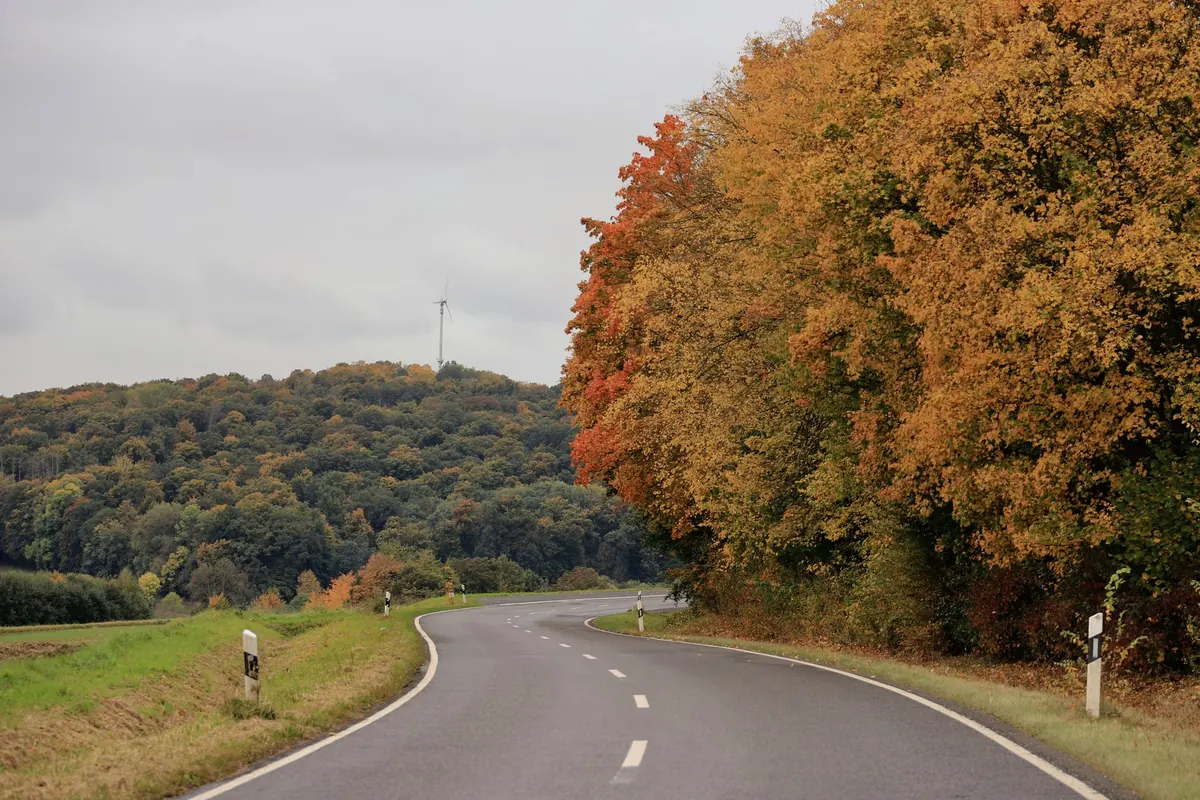
Autumn is the best season to drive through the New Forest and the easiest season to be caught out by it. The beeches along the Rhinefield Ornamental Drive turn copper, the low sun fires through the trees on the road towards Burley, and the ponies seem to know precisely when you are in a hurry. All of that arrives with wet leaves, fog sitting in the river valleys, deer on the move and a windscreen that refuses to clear. An hour spent on the car in late September buys you a whole season of better drives.
Wet leaves offer far less grip than most drivers expect, and a worn tyre makes that considerably worse. Check tread across the full width of the tyre and at several points around the circumference — the inside edge is the one that wears quietly out of sight. The legal minimum is 1.6mm, but a tyre at that depth is a poor tool for a wet Forest lane, and many drivers replace well before then. While you are down there, look for cracking between the tread blocks and any bulges or cuts in the sidewall.
Pressures next. Check them cold, against the figures on the sticker inside the driver's door shut or on the fuel filler flap, and remember that a fully loaded car usually needs more in the rear. Under-inflated tyres wear at the shoulders, run hot and move around on standing water.
Finally, find out what is under the boot floor. A space-saver, a full spare, or a can of sealant? If it is sealant, check the date. If it is a spare, check its pressure — a flat spare is a common and entirely avoidable discovery at the side of a lane with no signal.
Autumn takes the light away faster than most of us notice. Within a few weeks you will be using headlights on the morning run to Lyndhurst and switching them on again before you reach home.
Walk round the car with someone working the switches: dip, main beam, sidelights, indicators, brake lights, reverse. A failed rear indicator is easy to miss and always noticed at the worst moment. Clean the lenses while you are there — a film of grime cuts output more than you would think.
Fog lights have their own rules. Use them when visibility is seriously reduced, and switch them off when it improves; they dazzle other drivers and can mask your brake lights. If you cannot see more than around 100 metres, they are appropriate. Beyond that, they are a nuisance.
Then the glass. New wiper blades are one of the cheapest improvements you can make to an autumn car, and a smear across a low sun is genuinely dangerous. Top up screenwash with a mix strong enough for the temperatures you expect, not a splash of concentrate in a gallon of water. Run the air conditioning while you demist: it dries the air and clears the screen faster than heat alone. Cleaning the inside of the windscreen properly pays off twice, because interior haze is what turns low autumn sun into a white-out.
New Forest lanes collect debris in predictable places. Wet leaves gather on shaded bends under oak and beech, and they can be as slippery as ice. Treat a thick patch the way you would treat ice: slow down before it, keep the steering steady, and avoid braking or turning while you are on it. Junction mouths are where a lot of autumn incidents happen, because leaves get pushed into a dense layer exactly where you need to stop.
Watch for gravel washed onto the tarmac at car park entrances and forestry gates, and for mud drifting out of gateways where livestock cross. Standing water hides potholes and, in the worst spots, real depth. If you cannot see the bottom, do not assume it is shallow, and turn round where it is safe if you have any doubt.
And there is the sun. On a clear morning it can sit at precisely windscreen height on the road out of Brockenhurst or down towards Lymington. Keep sunglasses in the car, keep the screen clean, and ease off when you are driving into glare you cannot avoid.
Autumn is when the Forest's animals are most on the move. Pannage runs through the season, when commoners turn out pigs to eat acorns and beech mast, and it is not unusual to round a corner and find a dozen of them in the road. Deer are in the rut, which means they travel at odd hours and in odd directions, and a startled deer rarely chooses the sensible option.
Ponies, cattle and donkeys have priority over you. Some have stood on that verge for years and will not move for a bumper. Slow right down, be ready to stop and give them room. Do not get out to shoo them along, and do not feed them, however persuasive they are.
Many of the unfenced roads across the Forest carry a 40mph limit, and it exists for exactly this reason. Treat it as a maximum for perfect conditions, not a target. Dawn and dusk are the danger hours; if you can shift a journey to avoid them, do.
A small box of kit turns a nuisance into an inconvenience. None of it is expensive, and you will not need most of it — but you will be very glad of the torch the one evening you do.
Run through a short routine before any longer autumn drive in the Forest:
If the car does something you do not like the sound of — a wobble through the wheel, a warning light, a brake that pulls — book it into a garage you trust rather than hoping it settles down. Maintenance and roadworthiness are worth a professional eye, and a local independent will know the Forest roads as well as you do.
If you are standing at the door debating whether the conditions are bad enough to cancel, that is usually your answer.
Plan the drive, not just the car. Set off a little later to let the fog lift, take the main road when the lanes are thick with leaves, and build in a stop at a Forest pub so the journey is part of the day rather than a dash through it. Do that, and autumn in the New Forest is everything it is cracked up to be.
Photo: Christina & Peter / Pexels